

By Anu Adegbite
Trust Is the Real Currency of Digital Banking
Mobile banking has solved for speed, convenience, and scale. Consumers can open accounts in minutes, move funds globally, and access credit from the palm of their hand. Yet one critical problem remains unresolved: people still do not fully trust mobile banking platforms with their money, identity, and financial future. This trust deficit is now one of the most significant barriers to growth in digital finance.
Customers may download an app, but they hesitate to:
- Link their primary salary account
- Store substantial balances
- Use investment features
- Adopt new credit products
- Recommend the platform to others
For banks, fintechs, and digital lenders, this gap translates into lower activation, reduced retention, and diminished lifetime value. The challenge is not technological. It is neurological. The institutions that understand how the human brain makes trust decisions will define the next era of financial services.
The Hidden Psychology of Financial Trust
Trust is often treated as a rational decision, when in reality, neuroscience shows it is primarily an emotional and subconscious response. Before users read terms and conditions or compare interest rates, the brain asks three instinctive questions:
- Am I safe?
- Do I understand what is happening?
- Am I in control?
When the answer to any of these questions is uncertain, the brain activates threat-detection systems, particularly the amygdala. This increases cognitive stress and triggers avoidance behaviours.
In banking, avoidance looks like:
- Abandoning onboarding midway
- Delaying deposits
- Ignoring investment prompts
- Refusing to enable biometrics
- Closing accounts after minor errors
Conversely, when the brain perceives clarity, predictability, and control, it releases neurochemicals associated with confidence and reward, including dopamine and oxytocin.
Trust is not granted because an institution claims to be secure. Instead, it is granted when the brain feels secure.
Why Mobile Banking Still Feels Risky
Despite sophisticated security infrastructure, many digital banking experiences inadvertently trigger anxiety. The common friction points include:
- Ambiguous Onboarding
Requests for identity documents and facial scans without a clear explanation can feel invasive.
- Unexplained Delays
A pending transfer without context creates uncertainty.
- Inconsistent Interface Design
Sudden layout changes or unfamiliar workflows reduce predictability.
- Generic Messaging
Automated notifications that lack empathy feel cold and transactional.
- Hidden Processes
Customers are asked to trust decisions they cannot see or understand. These design choices create micro-moments of doubt. In finance, doubt compounds faster than interest.
The Business Cost of Distrust
Trust is not a soft metric. It is a commercial multiplier.
When trust is low:
- Customer acquisition costs rise
- Conversion rates decline
- Deposits remain shallow
- Cross-selling underperforms
- Support volumes increase
- Churn accelerates
- Brand advocacy weakens
When trust is high, customers consolidate financial relationships, adopt additional services, and become resilient during inevitable service disruptions. In mobile banking, trust is the strongest predictor of sustainable revenue growth.
The Neuroscience Framework for Trust-Centred Banking
At Nimble Consult, we help organisations design customer experiences aligned with how the brain naturally evaluates safety and reliability.
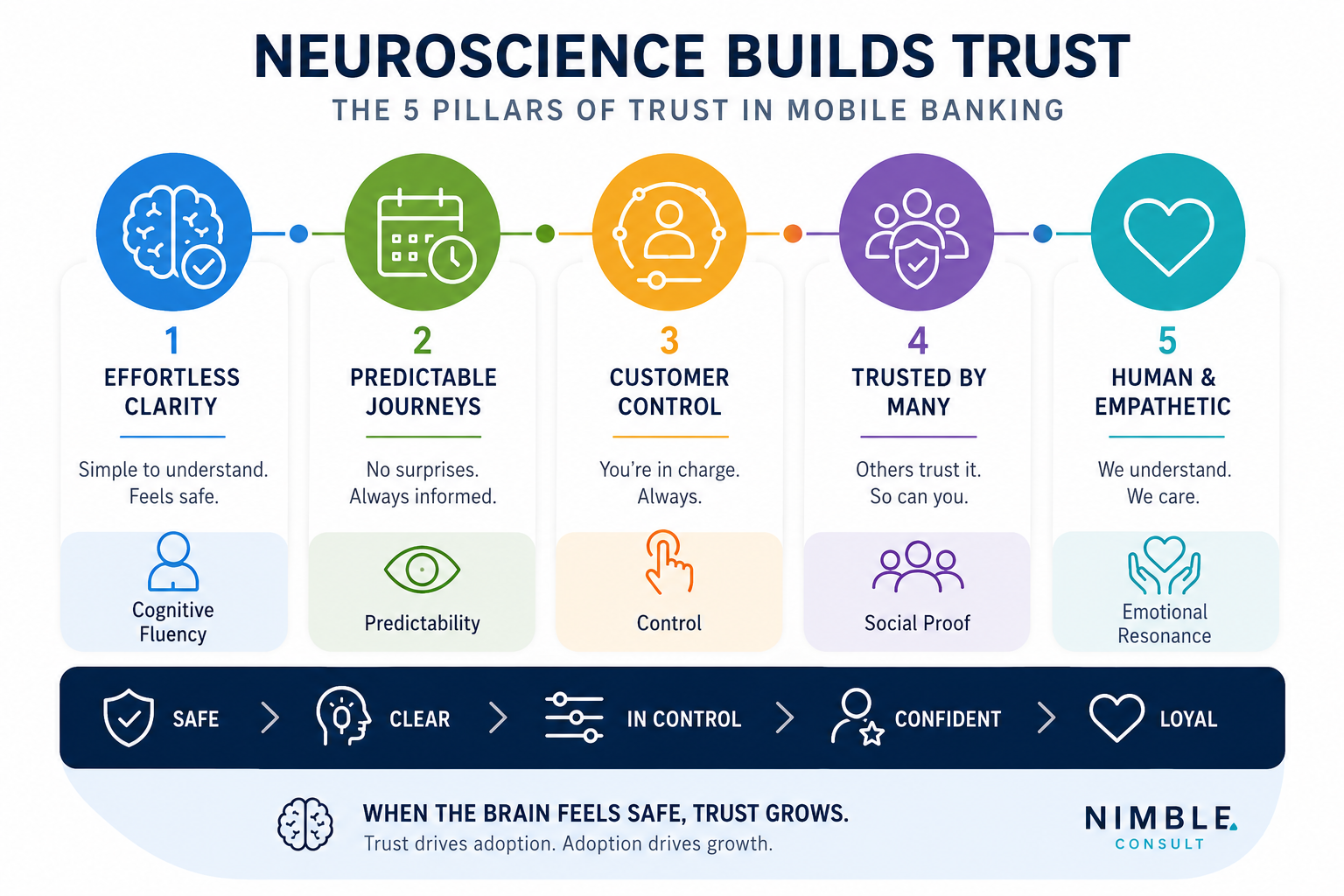
The most effective trust architectures are built on five neurological principles.
- Cognitive Fluency: Make Banking Feel Effortless
The brain equates simplicity with safety. When an interface is easy to understand, users subconsciously assume the institution is competent.
Practical Applications
- Reduce onboarding steps
- Use plain language
- Present one decision at a time
- Replace technical jargon with customer-centred explanations
Example
Instead of:
"Your KYC verification is under review."
Use:
"We're confirming your identity to keep your account secure. This usually takes less than two minutes."
The process is unchanged, but the emotional experience is transformed.
- Predictability: Eliminate Uncertainty
The brain dislikes ambiguity more than inconvenience. Users tolerate delays when they know what is happening and when to expect resolution.
Practical Applications
- Progress indicators
- Real-time status updates
- Transparent timelines
- Proactive notifications
Predictability converts waiting from a threat into an informed expectation.
- Control: Empower the Customer
Trust increases when users feel they remain in command.
Practical Applications
- Adjustable security settings
- Spending controls
- Instant card freeze/unfreeze
- Permission management
- Clear reversal options
Control reduces anxiety and strengthens commitment.
- Social Proof: Signal Collective Confidence
Humans are wired to trust what others already trust.
Practical Applications
- Verified customer reviews
- Transaction success statistics
- Security certifications
- Institutional partnerships
Signals such as "Trusted by over 5 million customers" provide subconscious reassurance.
- Emotional Resonance: Communicate Like a Trusted Advisor
Money is deeply emotional. Every interaction should reflect empathy, not bureaucracy.
Practical Applications
- Human-centred notifications
- Supportive tone during errors
- Celebratory milestones
- Calm crisis communication
A message that says, "Your payment is delayed, but your money is secure, and we're resolving it now," can preserve confidence during stressful moments.
From Functional Banking to Felt Security
Traditional design asks:
Does the app work?
Trust-centred design asks:
Does the customer feel safe using it?
This distinction is decisive. Consumers do not remain loyal to the platform with the most features. They remain loyal to the platform that consistently reduces uncertainty.
A Real-World Pattern We See Repeatedly
When financial institutions redesign critical customer journeys around neuroscience principles, the results are often immediate:
- Higher onboarding completion
- Increased first deposits
- Greater feature adoption
- Lower support contacts
- Improved retention
- Stronger Net Promoter Scores
The mechanism is straightforward. When the brain experiences less friction, trust increases. When trust increases, engagement deepens. When engagement deepens, revenue follows.
The Future of Banking Belongs to Institutions That Understand the Brain
Digital banking competition is no longer about who can launch features fastest. It is about who can create the strongest emotional sense of security.
The next generation of market leaders will combine:
- Behavioural science
- Neuroscience
- Human-centred design
- Data analytics
- Strategic execution
They will build platforms that do more than process transactions. They will build platforms customers instinctively trust.
How Nimble Consult Helps Financial Institutions Close the Trust Gap
Nimble Consult looks to partner with banks, fintechs, and financial service providers to design experiences that align with human decision-making.
Our work spans:
- Trust diagnostics across customer journeys
- Behavioural and neuroscience-based UX strategy
- Customer experience redesign
- Conversion optimisation
- Executive advisory for growth and innovation
We help organisations transform trust from an abstract aspiration into a measurable strategic asset.
In Summary
Consumers do not entrust their finances to technology. They entrust them to institutions that make them feel understood, protected, and in control. In mobile banking, trust is not built by telling customers your platform is secure. It is built by designing every interaction so the brain reaches one immediate conclusion:
"My money is safe here."
When that happens, adoption accelerates, loyalty strengthens, and growth becomes sustainable. That is where neuroscience becomes not just relevant, but transformational.
Nimble Consult helps organisations unlock growth by integrating strategy, behavioural science, and customer experience design.
Add comment
Comments