

By Anu Adegbite
Financial confidence is often treated as a compliance outcome – something that emerges once individuals follow the right rules, meet regulatory thresholds, or adopt prescribed financial behaviours. This framing is incomplete. Compliance can enforce discipline, but it does not rewire belief. And without belief, behaviour remains fragile. The real problem is not a lack of information. It is a lack of neurological alignment.
Global markets inundate individuals and executives alike with financial advice, including budgeting frameworks, investment strategies, and risk models. Yet hesitation persists. Decisions stall. Opportunities are missed. Not because the “what” is unclear, but because the “how” has not been internalised at a cognitive and emotional level. Financial confidence is not built through exposure to knowledge alone. It is built through repeated neurological reinforcement where understanding, emotion, and action converge into certainty.
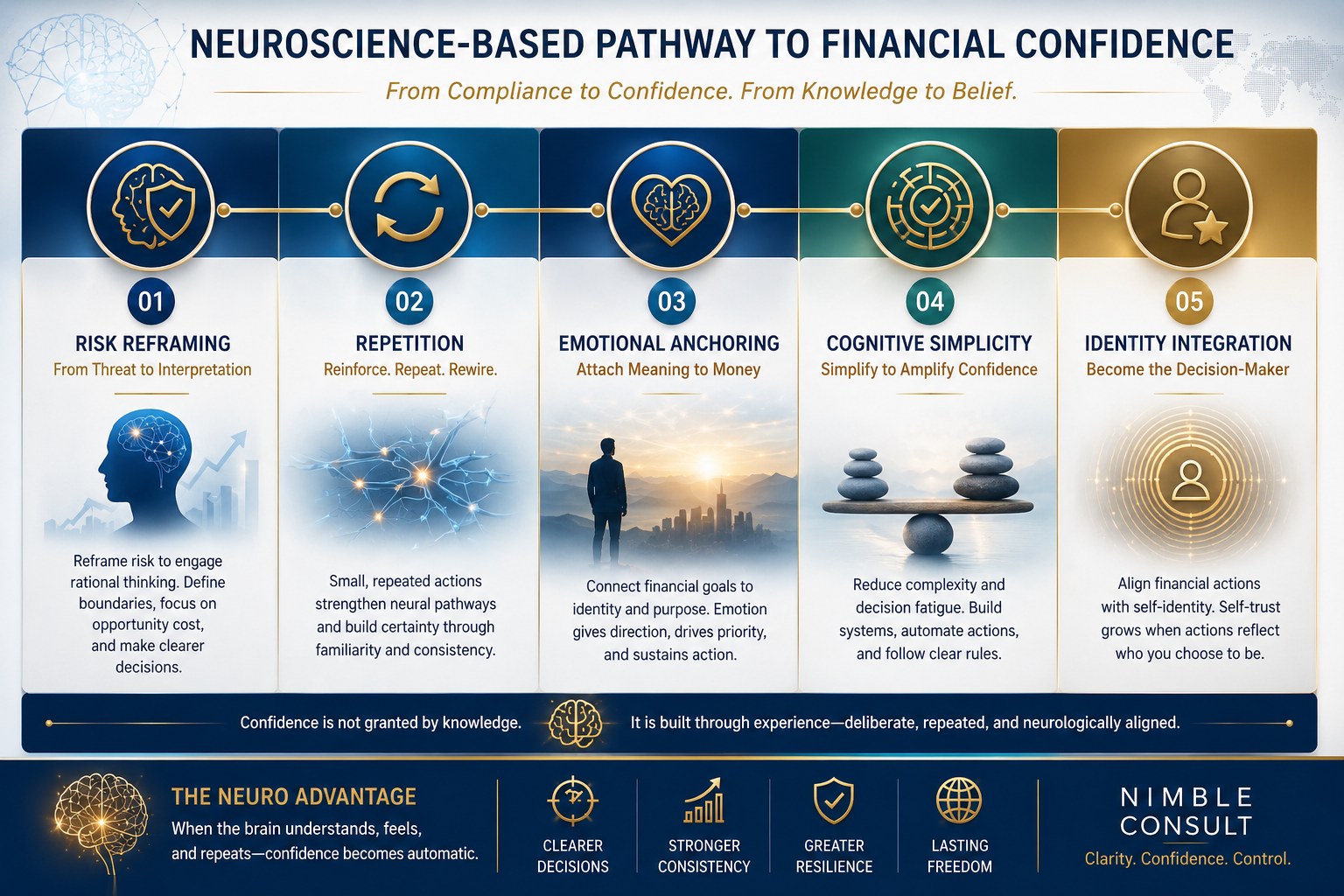
At Nimble Consult, we have found that the shift from compliance to confidence happens when financial behaviour is anchored in how the brain actually processes risk, reward, and uncertainty. Below is the complete framework; not a teaser, not a theory, but the full mechanism.
- Reframing Risk: From Threat to Interpretation
The brain does not process financial risk objectively. It interprets it. When individuals perceive risk as loss, the amygdala activates defensive responses—avoidance, delay, or over-conservatism. When the same risk is reframed as controlled exposure with defined boundaries, the prefrontal cortex engages—enabling analysis, planning, and decision-making.
Application: Instead of asking, “What could I lose?”, train the mind to ask, “What is the cost of not acting within defined limits?” This subtle shift moves the brain from fear to evaluation.
In practice, executives who adopt bounded-risk thinking—clearly defining downside thresholds before taking action—demonstrate faster, more confident decision cycles.
- Repetition Over Intensity: Building Neural Certainty
Confidence is not created by a single breakthrough moment. It is built through repetition. Neurologically, repeated exposure to a behaviour strengthens synaptic pathways. The brain begins to recognise the action as familiar, then safe, then automatic.
Application: Replace high-stakes, infrequent financial decisions with smaller, repeated actions:
- Regular micro-investments instead of sporadic large commitments
- Weekly financial reviews instead of quarterly overhauls
- Incremental exposure to new asset classes rather than immediate diversification
This is not a simplification. It is precision. Repetition reduces cognitive load and builds certainty at scale.
- Emotional Anchoring: Attaching Meaning to Money
Data informs decisions. Emotion drives them. Without emotional anchoring, financial actions remain abstract. The brain deprioritises abstract goals in favour of immediate stimuli. This is why long-term financial planning often collapses under short-term pressures.
Application: Attach every financial goal to a vivid, emotionally resonant outcome:
- Not “retirement savings", but freedom of time allocation
- Not “emergency fund", but decision independence under pressure
- Not “wealth accumulation", but multi-generational stability
When financial actions are tied to identity and meaning, the brain assigns them a higher priority and persistence increases.
- Cognitive Load Reduction: Simplifying Decision Architecture
Complexity erodes confidence. When individuals are presented with too many variables, the brain defaults to inaction. This is not a lack of capability, but a neurological efficiency mechanism.
Application: Design financial systems that reduce decision points:
- Predefined allocation models
- Automated transfers and investments
- Rule-based decision triggers (e.g., “If X occurs, execute Y”)
Confidence grows when decisions feel manageable. Simplicity is not a compromise; it is a strategic advantage.
- Identity Integration: Becoming the Decision-Maker
The most overlooked driver of financial confidence is identity. People do not consistently act outside of who they believe they are. If an individual does not see themselves as financially competent, no amount of external guidance will sustain behavioural change.
Application: Shift identity before expecting behavioural consistency:
- Replace “I’m learning about finance” with “I make informed financial decisions."
- Reinforce small wins as evidence of capability
- Track decisions, not just outcomes, to build self-trust
When identity aligns with action, confidence becomes self-reinforcing.
Bringing It Together
The pathway from compliance to confidence is not linear. It is layered:
- Reframe risk to engage rational processing
- Use repetition to build neural familiarity
- Anchor decisions in emotion to sustain action
- Reduce complexity to enable consistency
- Align identity to lock in behaviour
This is not theoretical. It is observable across high-performing individuals and organisations globally. Those who internalise these principles do not just follow financial systems; they trust themselves within them.
The Real Shift
The traditional model says: Learn more, then act. The neurologically aligned model says: Act in structured ways, and the brain will learn to trust.
That distinction changes everything, because financial confidence is not granted by knowledge. Rather, it is constructed through experience—deliberate, repeated, and neurologically aligned. And once built, it does not depend on external validation. It becomes an internal asset—scalable, transferable, and resilient across any economic environment.
At Nimble Consult, this is the standard. Not guidance that informs, but frameworks that transform.
Add comment
Comments