

Written By: Anu Adegbite
Trust Is Decided Before Logic Ever Shows Up
Most organisations still design for the rational mind—features, compliance badges, and performance metrics. However, trust doesn’t begin with logic. It begins in milliseconds. Before a user reads a word, before they explore a feature, the brain has already made a decision:
Is this safe? Do I stay—or do I leave?
This is not a theory. It is human biology. In less than 100 milliseconds, the brain evaluates your app through its threat-detection and pattern-recognition systems. A subconscious verdict is reached long before conscious thought. And globally across cultures, industries, and user types, the pattern is consistent: Users don’t leave because they don’t understand. They leave because something feels off. That feeling is not subjective. It is neurological.
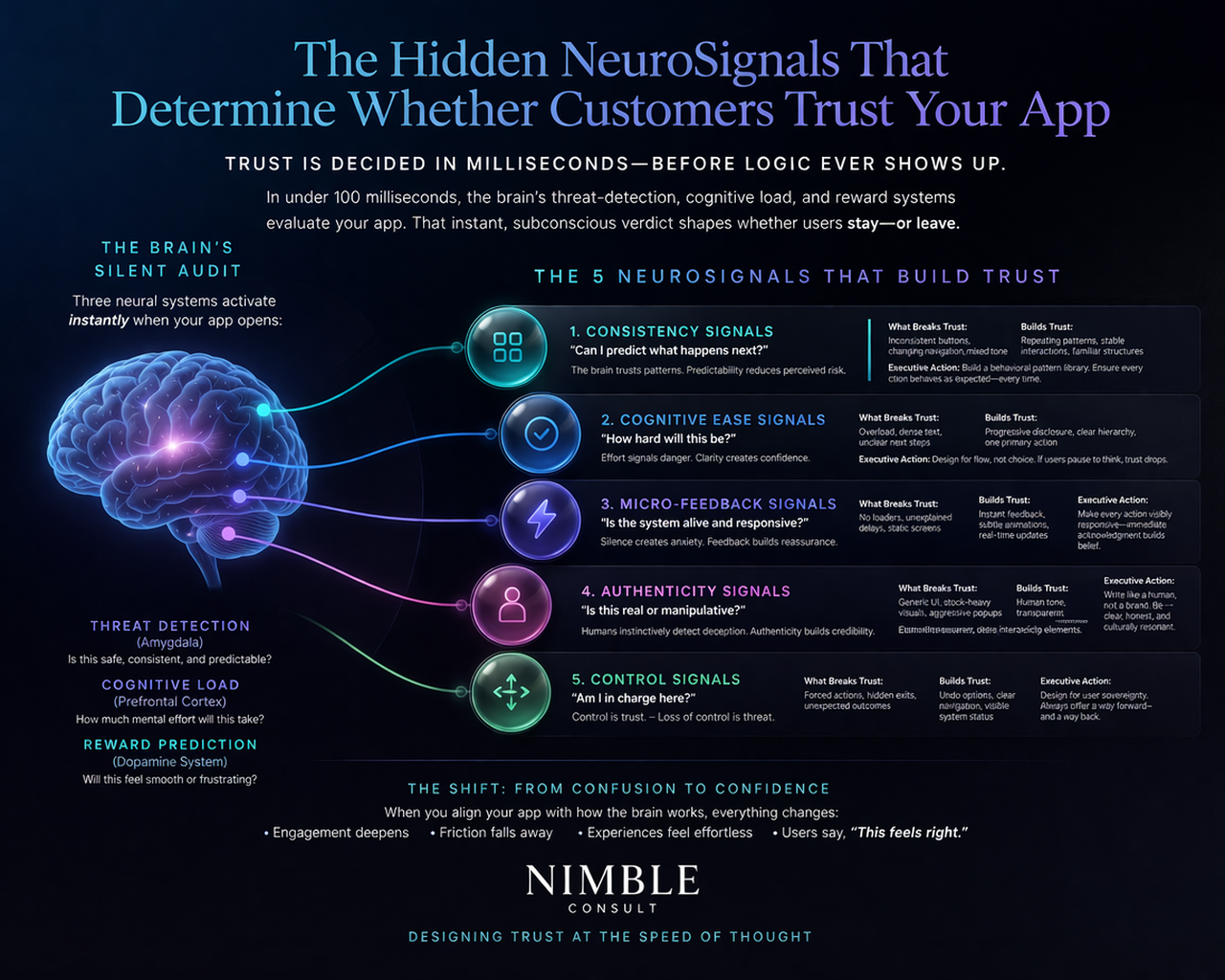
The Silent Audit Every Digital Experience Faces
Every time your app opens, the brain runs a rapid, universal audit:
- Threat Detection (Amygdala): Is this safe, coherent, and predictable?
- Cognitive Load (Prefrontal Cortex): How much effort will this require from me?
- Reward Prediction (Dopamine System): Will this experience feel smooth—or frustrating?
If your product introduces friction, ambiguity, or delay, trust erodes instantly, often irreversibly. No onboarding flow can recover that first impression. No feature set can compensate for it.
The Leadership Blind Spot
The data is widely known:
- Users rarely return after poor experiences
- Visual design drives immediate credibility
- Early friction drives disproportionate churn
Yet most strategies still optimise for what users say, not what their brains register. The gap lies in what we define as 'NeuroSignals'—the invisible cues that determine whether a user proceeds with confidence or withdraws without explanation.
Designing for NeuroSignals: A Strategic Imperative
At Nimble Consult, we’ve seen this pattern across markets from emerging digital ecosystems to mature global platforms. In one case, a high-performing product—with strong features and positive feedback—was underperforming in retention. The issue was not capability. It was perception. The experience was quietly triggering distrust at a neurological level. We didn’t rebuild the product. We realigned it with how the human brain works by applying the following frameworks:
The Five NeuroSignals That Build (or Break) Trust
- Consistency Signals — Trust Follows Predictability
The brain trusts patterns it can recognise.
Break trust: inconsistency, shifting behaviours, and mixed signals. Build trust: repetition, stability, familiar interaction logic
Move beyond design systems. Build behavioural consistency across every touchpoint. Predictability reduces perceived risk across cultures and user groups.
- Cognitive Ease Signals — Effort Equals Risk
When something feels difficult, it is perceived as unsafe.
Break trust: overload, ambiguity, and decision fatigue. Build trust: clarity, hierarchy, guided progression
Design for flow, not volume. Reduce decision points. If users hesitate, trust is already declining.
- Micro-Feedback Signals — Responsiveness Builds Reassurance
Silence creates doubt.
Break trust: delays without feedback, static states. Build trust: immediate responses, visible system activity
Ensure every interaction produces instant feedback. Responsiveness signals reliability—across all digital maturity levels globally.
- Authenticity Signals — Humans Instinctively Detect Manipulation
Trust is deeply tied to perceived authenticity.
Break trust: overly polished interfaces, generic messaging, aggressive prompts. Build trust: human tone, transparency, grounded realism
Localise tone without losing humanity. Speak clearly, honestly, and directly—across cultures and contexts.
- Control Signals — Autonomy Creates Psychological Safety
Control is a universal trust driver.
Break trust: forced actions, hidden exits, unpredictable outcomes. Build trust: reversibility, clarity, visible pathways
Design for user sovereignty. Every user, anywhere in the world, must feel in control of their journey.
What Changes When You Align with the Brain
When these NeuroSignals are aligned, transformation is immediate:
- Engagement deepens
- Friction reduces
- Experiences feel intuitive—across markets
Nonetheless, the most powerful shift is qualitative. Users stop asking: “How does this work?” They start saying: “This feels right.” That is trust; unspoken, instinctive, and scalable.
From Invisible Signals to Global Advantage
If your product is underperforming, the issue may not be strategy or capability. It may be a misalignment with the brain’s universal operating system.
To correct it:
- Prioritise predictability over novelty
- Reduce cognitive demand at every step
- Make responsiveness visible
- Communicate with human clarity
- Preserve user control
Trust is not built through persuasion. It is felt through alignment.
Final Perspective
Most organisations optimise for feedback. Leading organisations design for perception. At Nimble Consult, we position trust not as a feature, but as a neurological outcome. This is because in a world of increasing digital choice, the products that win are not the ones users understand the most, but the ones they trust the fastest.
Add comment
Comments